
Asphalt vs. Concrete: Safety, Ease of Construction & More
Categories
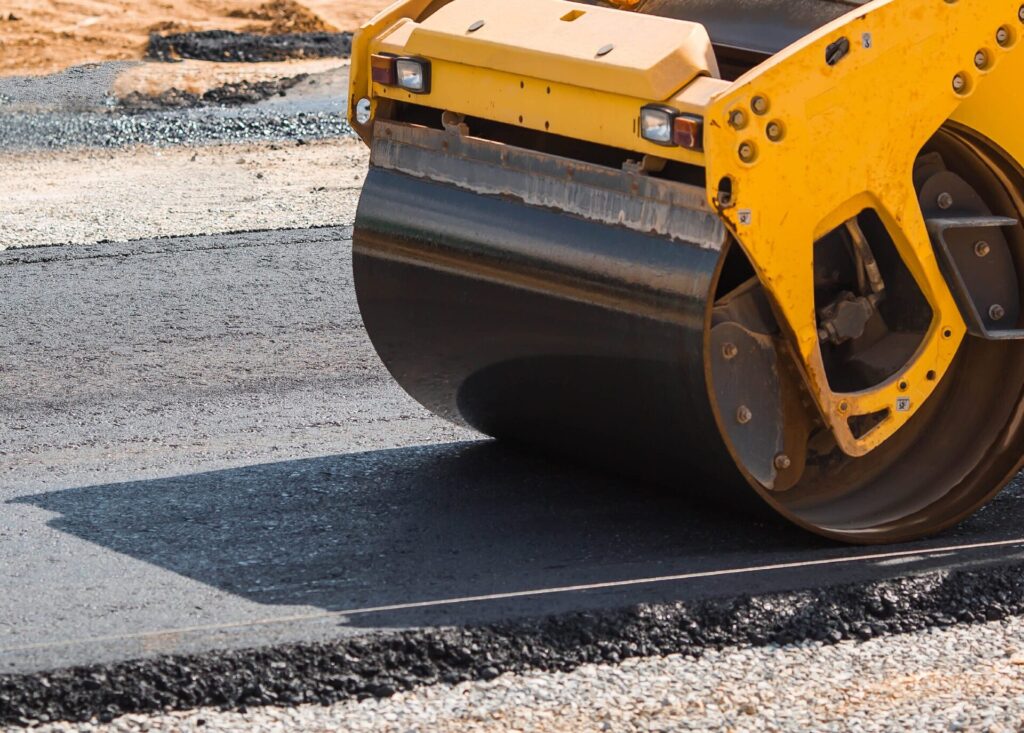
Table of Contents
- Why Asphalt Construction Is Faster Than Concrete Construction
- The Benefits of Stage Construction
- Asphalt vs. Concrete: Safety, Cost and Community Impact
When most people think about road construction, the first word that comes to mind probably isn’t “fast.”
However, when it comes to asphalt pavement, construction speed is actually one of its most significant (and underappreciated) advantages. See how asphalt pavement ranks better than concrete for ease of construction, safety and more.
[ Video coming soon ]
Why Asphalt Construction Is Faster Than Concrete Construction
The difference between building an asphalt road and a concrete road becomes apparent almost immediately.
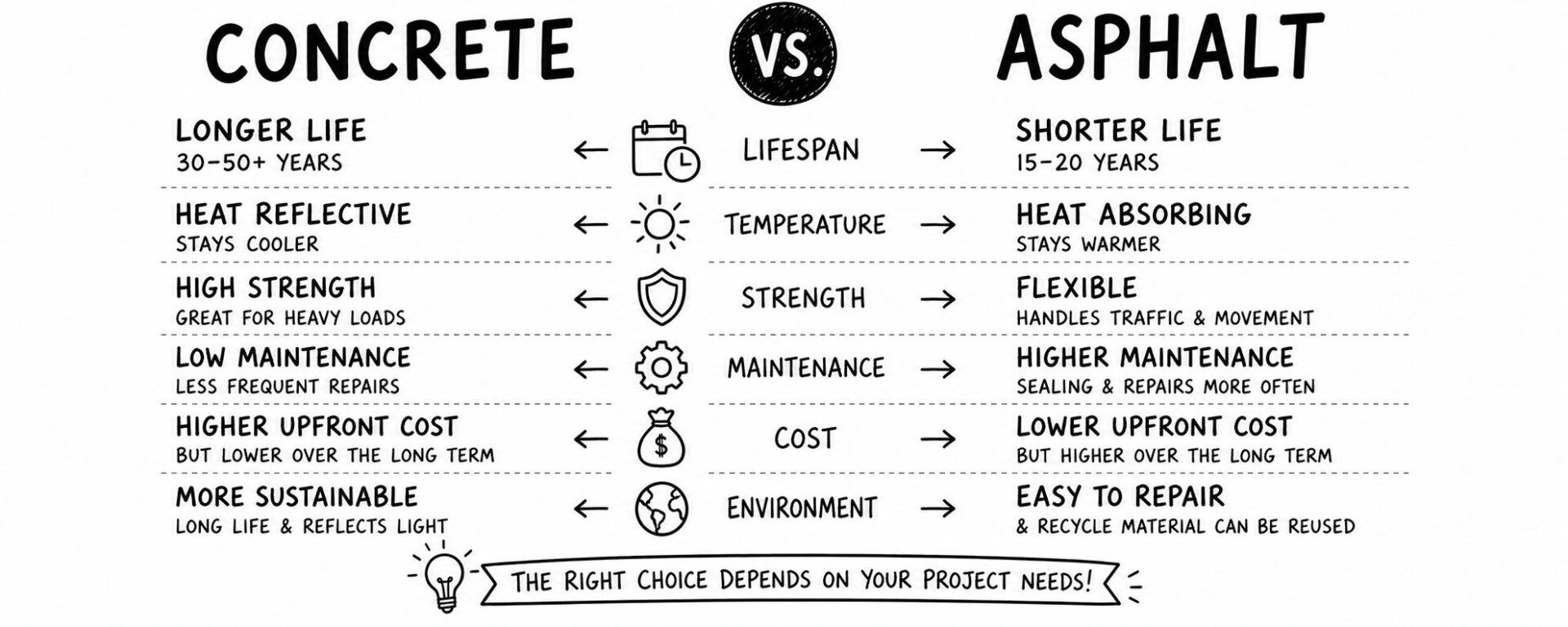
With concrete, every step in the process requires waiting. You set forms, tie rebar, pour the concrete, cut joints and then wait. At minimum, you typically wait three to five days for curing—possibly even seven days. After that, you still have to come back and seal the joints. From start to finish, opening a single lane of concrete pavement to traffic typically takes no less than two weeks.
With asphalt, that same lane can be open to traffic in a matter of hours. There are no forms to set. Once the surface is excavated and graded, the pavers go down, the trucks back up and the mix is laid and compacted. As soon as it cools, traffic can come through. That two-week minimum gets compressed into a single workday.
This difference is felt the most in residential neighborhoods. With concrete, homeowners may be locked out of their own driveways for a week or more—even when contractors are doing everything right and using high-early-strength mixes to speed up cure times. With asphalt, it’s only a matter of hours before a driveway is accessible again.
This same advantage also applies to maintenance. When a pothole or damaged section needs to be repaired, both concrete and asphalt require cutting and removing the affected material. However, concrete requires doweling into the surrounding pavement, tying steel, pouring and waiting days to cure, while asphalt is filled, compacted and open to traffic again almost immediately.
There’s also a structural design flexibility built into asphalt that concrete simply can’t match. Since asphalt is placed in lifts, contractors can vary the mix type and binder grade at each layer. A more economical mix can go at the bottom, where different stresses are at play, while the surface layer gets a mix optimized for smoothness and durability.
With concrete, whatever material and strength specification you commit to runs the full depth of the mix. In other words, high-early-strength concrete, if needed, has to go all the way down, which significantly increases cost.
The Benefits of Stage Construction
One of the most practical (and often overlooked) advantages of asphalt is its ability to be built in stages, also known as stage construction.
In a new subdivision or large industrial development, all base and intermediate asphalt layers can be placed first, before the project is complete. That surface can then carry construction traffic, such as heavy trucks, concrete mixers and flatbeds delivering roof trusses, throughout the development process. Workers can backfill, pour sidewalks, install streetlights and plant grass, all while driving on a functional asphalt base.
Any weak spots in the subgrade that may not have been apparent during initial construction are revealed under real-world loads. This allows those weak spots to be identified and repaired before the final surface ever goes down. Then, at the very end of the project, a fresh, clean surface layer gets laid and striped.
Contractors walk away from a brand-new surface that’s only days old rather than a surface that’s been gouged, scuffed and worn down from months of construction activity. That’s a meaningful difference in long-term durability, especially in Texas, where challenging subgrade soils can cause problems down the road.
Asphalt vs. Concrete: Safety, Cost and Community Impact
The speed advantage of asphalt construction isn’t just a matter of convenience. It has real implications for safety, economics and community well-being.
From a worker safety standpoint, every additional day spent in a live construction zone next to moving traffic is another day of risk. Concrete barricades and barrels can define a work zone, but they don’t eliminate the danger of working alongside vehicles traveling at high speeds. The faster a project can be completed, the less exposure workers have to that risk, and the less opportunity there is for driver frustration to translate into dangerous behavior near work zones.
There’s also an economic ripple effect to consider. User delay costs, or the economic impact of slowing or restricting traffic flow, are real and quantifiable. Delayed deliveries, longer commutes, and disrupted access all carry costs that are eventually passed along.
Beyond logistics, there’s also a direct impact on local businesses. For a small business operating on a street that’s under construction, every day of restricted access is a day of lost customers. Extended concrete construction timelines have, in documented cases, put small businesses under entirely.
With asphalt’s significantly shorter construction windows, that risk is dramatically reduced.
The same applies to residents. Getting people back into their neighborhoods, back in and out of their driveways and back to normal life isn’t just a nicety—it’s a measure of how well a construction project serves the community it’s built for.
To review, the ease of construction with asphalt pavement can deliver:
- Dramatically faster timelines compared to concrete
- Same-day traffic reopening
- Greater structural flexibility through layered mix design
- Stage construction capability that protects the final surface quality
- Reduced worker exposure and improved job site safety
- Lower economic disruption for businesses and residents
For more asphalt pavement industry insights, subscribe to our YouTube channel and tune in to our newest podcast, Road Maps for Texas Local Agencies.