The Surface Prep Checklist Every Local Agency Needs Before Paving
Categories
Table of Contents
- What Counts as Surface Prep?
- Prime Coat vs. Tack Coat: Know the Difference
- Crack Sealing: When It Helps, & When It Doesn't
- Milling and Level-Up: Setting Up a Smooth Ride
- The Materials Producer List (MPL)
If you're going to paint a house, you don't just show up and get started. First, you look for the windowsill that needs replacing, the trim board that's rotted out, and the surface that needs to be scraped and cleaned before the paint ever goes on. If you skip that step, the house might look fine on day one, but it won't look good a year later.
Asphalt pavement works the same way. Surface preparation is one of the most overlooked yet most important parts of a paving project. Get it right, and the new surface bonds properly, ages well, and performs the way it was designed to. Get it wrong, and no amount of good asphalt on top will fix what's happening underneath.
Here's what local agencies need to check before the paving crew arrives.
What Counts as Surface Prep?
Surface prep starts with an honest look at what's actually happening below the pavement, not just what's visible on top.
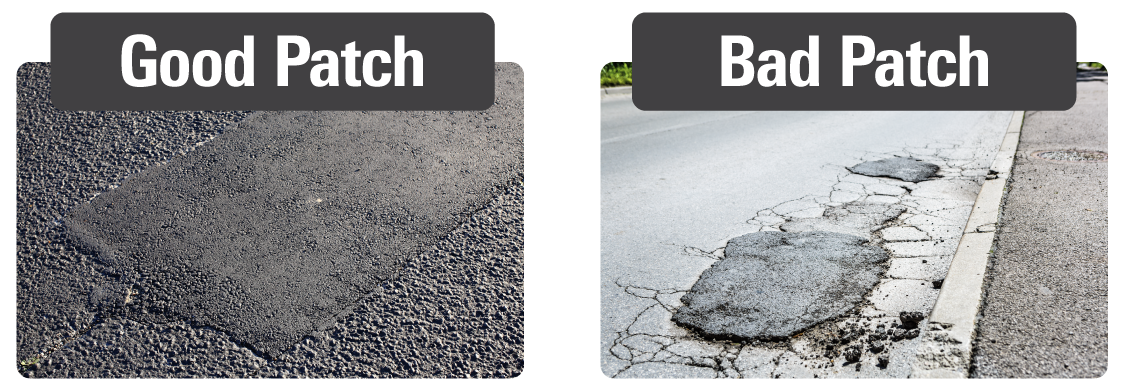
Patching is one of the most common surface prep activities, and it's also one of the most commonly rushed. A few rules of thumb apply across the board:
- Patches should be cut square, not round
- Patches should also be cut back into good material, whether that's six inches deep or more, depending on the pavement section
- Joints in a patch or base repair should never land in a wheel path, for the same reason a longitudinal paving joint avoids that location
- Lift thicknesses for the patching material should match standard asphalt lift thicknesses
- The patch needs to be sized so that the right compaction equipment can actually get in and do its job
- When in doubt, agencies are generally better off creating a larger patch rather than several smaller ones scattered close together
That said, patching alone doesn't solve every problem. Cracking in a wheel path, especially alligator or fatigue cracking, is often a symptom of something happening below the surface rather than a failure of the asphalt itself.
Before applying any surface treatment, it's worth asking whether the real issue is a base or subgrade problem. Surface-only fixes can resolve visible distress overnight, but structural and drainage issues require base repair, reclamation, or reconstruction, not another layer of asphalt on top.
This is also where project-level planning matters. Base and subgrade repair quantities estimated during design can shift significantly by the time a project is let for construction, particularly if there's a lag between data collection and paving. Building in some contingency and staying in conversation with contractors about what they're actually finding in the field can help agencies avoid being caught off guard by quantities that don't match what's in the bid package.
Prime Coat vs. Tack Coat: Know the Difference
Prime coat and tack coat both play a role in surface prep, but they're not interchangeable, and mixing them up can affect how well a new layer bonds.
Prime coat is a thicker, oil-based material applied to a non-asphalt surface, like a base course. Its job is to seal the surface against moisture, stabilize it, and promote bonding with the asphalt layer that goes on top.
Tack coat functions more like glue between two asphalt surfaces. It should cover the entire surface that will receive the next layer, with no bare pavement visible underneath once it's applied. If there’s too little tack, the surface won't bond properly. If there’s too much, it can cause issues like bleeding.
Both materials need a clean, dry surface to work correctly, and application rates should be based on the surface type and texture being treated. Agencies should reference the approved product list for both, since not every prime or tack material on the market is designed to perform the same way. Distributor trucks also need the correct nozzle setup for the specific material being applied, since a prime coat nozzle setup differs from a tack coat setup.
One additional option worth knowing about is trackless tack. In areas with heavy construction traffic or unavoidable driveway access, trackless tack helps prevent material from being tracked across lanes and off the project site.
Crack Sealing: When It Helps, & When It Doesn't
Crack sealing is a useful and relatively inexpensive maintenance technique, but it's not a cure-all, and timing matters.
Crack seal generally shouldn't be applied immediately before an overlay. It typically needs time to age—ideally a season, but at minimum a couple of months, before paving begins. Applying the right amount of material matters, too. Overbanding, or applying more material than needed to fill the crack flush with the surface, can create problems that show up later.
Most importantly, crack sealing is a maintenance technique, not a structural solution. It can extend the life of a pavement with existing cracking, but it won't address base or subgrade failures underneath. Treating symptoms on the surface without confirming what's happening below can mean a treatment that doesn't hold up as long as expected.
Milling and Level-Up: Setting Up a Smooth Ride
Milling, the process of mechanically removing an existing asphalt surface, sets the stage for everything that comes after.
Proper planning matters here as much as execution. Before milling begins, agencies should:
- Confirm that the milling equipment is right for the job, including achievable depth and width
- Account for manholes, curbs, inlets, and any features that shouldn't be cut through, especially on city streets
- Consider drainage, since a milled surface exposed to rain before paving can create its own set of problems
- Check that the paving schedule keeps pace with the milling schedule (you don’t want an exposed milled surface left in place for months)
Level-up addresses a related but different issue: getting a uniform, consistent surface before the final layer goes down. Local agency streets often have inconsistent underlying surfaces, sometimes with partially removed layers, or "scabs," left behind. Level-up fills in those inconsistencies so the final surface has a smooth, uniform base to build on.
Ride quality is one of the clearest indicators of a well-executed paving project, and it's also one of the criteria TXAPA quality award winners are consistently strong on. Smoothness generally improves with each successive lift, but that improvement has limits. Getting the underlying surface level and uniform before the final lift gives a project its best chance of a smooth result, rather than relying on the final layer to compensate for problems underneath.
The Materials Producer List (MPL)
Every prime, tack, and emulsion material used on a Texas asphalt project should come from TxDOT's Material Producer List, or the MPL.
This list, also referenced in TXAPA’s 341M spec, identifies vetted suppliers whose materials have already been evaluated and approved. Local agencies generally don't have the time or resources to independently test and validate a new, unlisted material, which is exactly why the MPL exists. If a product isn't on the list, it probably shouldn't be used on the project, regardless of how it's marketed.
Surface preparation isn't the most visible part of a paving project, but it's the foundation that everything else is built on. If you follow this checklist before your next project, you’ll be one step closer to creating a smooth, long-lasting roadway.
Have a project you'd like to talk through? Reach out to our team, and we’d be happy to sit down and chat. For more asphalt pavement industry insights, subscribe to our YouTube channel and tune in to our podcast, Road Maps for Texas Local Agencies.
FAQs
What is surface preparation in asphalt paving?
Surface preparation refers to the steps taken before a maintenance treatment or overlay is applied, including patching, addressing base or subgrade issues, and applying prime or tack coat, to ensure the new asphalt layer bonds properly and performs as designed.
What are good patching practices?
A few good patching practices include cutting them square, cutting them back into good material and not having joints in a patch land in a wheel path. When it comes to lift thicknesses, they should match standard asphalt lift thicknesses. Finally, it’s typically better to create a larger patch rather than a smaller patch.
What's the difference between prime coat and tack coat?
Prime coat is applied to non-asphalt surfaces, like a base course, to seal and stabilize them before paving. Tack coat is applied between two asphalt layers to promote bonding.
Can crack sealing replace an overlay?
No. Crack sealing is a maintenance technique that can extend pavement life, but it’s not a structural solution and won't address base or subgrade failures.
What is the Materials Producer List (MPL)?
The MPL is a Texas Department of Transportation-maintained list of approved material suppliers for products like prime coat and tack coat. Materials not on the list shouldn't be used on Texas asphalt paving projects.