
Recycled Asphalt Pavement (RAP): What Local Texas Agencies Need to Know
Categories
Table of Contents
- Myth vs Fact: Common Misconceptions About RAP
- Why RAP Makes Sense for Local Agencies
- What Is Fractionated RAP, & Why Does It Matter?
- How Much RAP Can Be Used?
- Does TxDOT Allow RAP?
- A Regional Note: Test Your Local Materials
- Frequently Asked Questions
Recycled asphalt pavement, or RAP, is the material collected when an existing asphalt road is milled up during a paving project. It's the most recycled material in the United States, with millions of tons stockpiled every year. When it's properly processed and tested, it can be reintroduced into a new asphalt mix at meaningful percentages.
For local agencies, this means an opportunity to lower project costs, support sustainability goals and, if done right, maintain the performance a new road is designed to deliver. Some agencies still hesitate to allow RAP, and that hesitation is usually rooted in real experience, whether it’s mixes from years past where too much RAP was used, or RAP that wasn't processed properly before it went into the mix. However, modern specifications and testing have closed most of those gaps.
Here's what local agencies should know before deciding how RAP fits into their next project.
Myth vs. Fact: Common Misconceptions About RAP
Myth: RAP is a lower-quality material, so it means lower-quality pavement.
Fact: When RAP is properly fractionated, tested and incorporated at an appropriate percentage, it doesn't have to mean a drop in performance. Some of the concern around RAP is grounded in past projects where it wasn't processed correctly, not in the material itself.
Myth: If some RAP is good, more RAP is better.
Fact: RAP content has to be engineered like any other material source, with attention to both the overall RAP percentage and the recycled binder ratio. Maximizing RAP content without running the appropriate testing and mix design isn't a shortcut worth taking.
Myth: Allowing RAP means accepting an asphalt road built partly from debris.
Fact: Properly fractionated RAP is screened to remove harmful material and tested for gradation and asphalt content. The same rigor applied to any qualified aggregate source is also used on RAP.
Why RAP Makes Sense for Local Agencies
For starters, RAP is already sitting at the plant, which means less new aggregate and less new binder have to be ordered and trucked in for that day's mix. That lowers supply chain demand and, typically, production cost.
Properly engineered RAP can also improve a mix's performance in some cases. Balanced mix design research underway across the state is specifically testing how much RAP a given mix can carry while still resisting both rutting and cracking, using tests like the Hamburg wheel alongside cracking tests rather than just a volumetric check.
There's a performance-driven savings opportunity with RAP, too. Since RAP brings its own effective binder content into the mix (and that binder tends to be stiffer), it can sometimes allow a lower, less expensive binder grade to be specified for the same intermediate-layer performance. For example, you could use a 64-22 binder in a spot that would otherwise call for a more heavily modified 70-22.
Additionally, RAP is the most recycled material in the country, and using it responsibly checks a sustainability box that a growing number of local agencies are being measured on.
What Is Fractionated RAP, & Why Does It Matter?
Fractionated RAP is RAP that has been processed down to a consistent gradation, or separated into finer and coarser aggregate fractions, rather than used straight off of an unprocessed stockpile.
This processing matters because:
- It allows the material to be tested reliably for gradation, asphalt content and the presence of any harmful material that needs to be screened out
- Finer RAP fractions carry a higher asphalt content, which affects how much effective binder that fraction contributes to the mix
- Stockpiles at a plant are often a blend of millings from multiple past projects, and fractionating gives producers a way to characterize that blended material consistently, instead of treating it as a single unknown
Unfractionated RAP isn't recognized under modern specifications. If a spec calls for RAP, it's calling for fractionated RAP.
How Much RAP Can Be Used?
RAP allowances aren't uniform across a pavement structure. Local agencies should expect two things to be checked together: the overall RAP content and the recycled binder ratio (the portion of the total binder in the mix that comes from the RAP itself, rather than new binder). In some parts of the state, it's the recycled binder ratio and not the raw RAP percentage that ends up being the limiting factor.
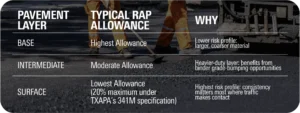
A mix can be engineered up to these ceilings, but reaching the ceiling isn't the goal on its own. The recycled binder ratio and performance testing determine what percentage is actually appropriate for a given RAP source and mix design.
Does TxDOT Allow RAP?
Yes, TxDOT allows RAP. Some TxDOT districts previously prohibited RAP, but that trend has reversed, supported by a strong working relationship between TXAPA and TxDOT's Materials and Tests Division. TxDOT has actually published a stockpile management guidance document(opens in new tab) covering best practices for RAP handling and processing. Local agencies specifying RAP on a city or county project should make sure their specifications reflect these recommendations.
TXAPA's 341M specification(opens in new tab) is built on this same foundation, starting with fractionation and testing, and provides local agencies with a straightforward path to responsibly allow RAP.
A Regional Note: Test Your Local Materials
The 20% surface mix ceiling is a maximum, not a target. What actually works best depends on the aggregate, binder and RAP source in a given area.
For instance, in far South Texas, some of the region's producers have found that their sweet spot for surface mix lands closer to 8–9% (well under the 20% allowance), based on how their local materials perform.
The takeaway for any agency evaluating RAP is to treat published maximums as a starting point, not a rule of thumb to build a bid package around. Run the mix design, check the recycled binder ratio and let local testing tell you what percentage actually holds up.
FAQs
What is recycled asphalt pavement (RAP)?
RAP is the material collected when an existing asphalt road is milled up during a paving project. It's the most recycled material in the U.S. and can be reintroduced into new asphalt mix at engineered percentages.
Is RAP lower quality than virgin asphalt?
RAP isn’t of lower quality than virgin asphalt when it's properly fractionated, tested and used at an appropriate percentage. Past quality concerns generally trace back to unprocessed RAP or overuse rather than the material itself.
What percentage of RAP can be used in asphalt paving?
It varies by pavement layer, with base layers allowing the most, intermediate layers less and surface mixes capped at 20% under TXAPA's 341M specification. The recycled binder ratio, not just the raw percentage, often determines the practical ceiling.
What is fractionated RAP, and why does it matter?
Fractionated RAP has been processed into consistent aggregate gradations so it can be reliably tested for gradation, asphalt content and deleterious material. Unfractionated RAP isn't recognized under modern specifications.
Does TxDOT allow RAP in paving projects?
Yes. TxDOT allows RAP and has published stockpile management guidance in partnership with TXAPA's Materials and Tests Division, reversing an earlier trend of some districts restricting its use.
For more asphalt pavement industry insights, subscribe to our YouTube channel(opens in new tab) and tune in to our newest podcast, Road Maps for Texas Local Agencies(opens in new tab).